Benjamin F. Johnston - Born: March 23, 1829 - Died: March 1, 1914
The story of one Civil War prisoner
...The Poem "Prisoner's Appeal" by Benjamin F. Johnson...
Written while confined in Andersonville Prison, Georgia, in 1864.
Obituary and letter to follow.
Prisoner's Appeal
Friends of Freedom, one and all,
Pray do listen when we call,
For release from this earthly hell,
The horrors which no tongue can tell,
Exposed we are to disease and death,
Lying upon the filthy earth,
Unprotected from storms and heat,
Little, unwholesome, food to eat.
Thirty-five thousand are here confined,
Inside these walls of Georgia Pine.
The acreage which we occupy,
Is twenty-two, both marsh and dry;
Completely covered over with filth,
Throwing off a sickening stench.
The only water to quench our thirst*
Runs between the rebel's post.
Thousands confined in this stockade,
Volunteered their country's aid;
Left their homes and kindred too,
Protecting the flag, red, white and blue.
Many times we all have faced,
The cannon's mouth without disgrace,
Proving our willingness to fight,
Against oppression for freedom rights.
Through misfortune, not for crime,
We are in these walls confined,
Far away from home and friends,
Expecting soon our days to end;
Starving, thirsting* every day,
Until our flesh has shank away,
Leaving nothing but skeletons,
For myriads of vermin to feast upon.
The sufferings here can ne'er be told,
By finite tongues, young or old;
Possessing one like Demosthenes,
Cannot describe the horrid scenes.
Neither the eloquence of Cicero,
Can proclaim them so you know,
Our true condition, our wretched state,
Language is wholly inadequate.
We love our homes and kindred too;
Must we here bid them adieu?-
Remained confined inside this pen,
Until our days on earth do end,
Where no relief does ever come.
To the sick and fevered one,
No heart to sigh, no tear to shed,
O'er the dying and the dead.
Thirteen thousand heroic men,
Already have died inside this pen;
Died alone in deep distress,
Without a place for their head to rest,
Excepting upon the filthy ground,
Where lice and vermin can be found,
Completely covering their ghostly forms,
Before their spirit had fled and gone.
Again to our friends we do appeal,
To get us away before you yield,
For life's sake do all in your power.
We're growing weaker every hour,
Then, oh then, release us soon,
Or awe shall face that awful doom,
Dying alone without a friend,
Inside this filthy horrid pen.
*until after providence Spring broke out, in August, 1864
BENJAMIN F. JOHNSTON
I enlisted on the 16th of August, 1862, at Almont, Lapeer County,
Mich., as a private in Company A of the 5th Regiment Michigan Cavalry.
Mustered in the United States service at Detroit on the 26th of August
1862, and left Detroit for Washington, D.C. on the 6th of December
1862, arriving there on the 9th, and went into winter quarters on East
Capitol Hill. Our regiment, in the spring, joined the army of the
Potomac and I was taken prisoner on the 11th of June 1864, at
Trevillian Station, Va. Taken first to Libby Prison in Richmond, Va.,
and from there to Andersonville Ga., where I was confined until the
25th of March, 1865. I was paroled out and sent to Vicksburg, Miss.,
arriving at Black River on the 1st of April 1865, crossed the river and
went into camp, remaining there until the 24th of April, afterwards
marching about four miles to Vicksburg where we went on board the
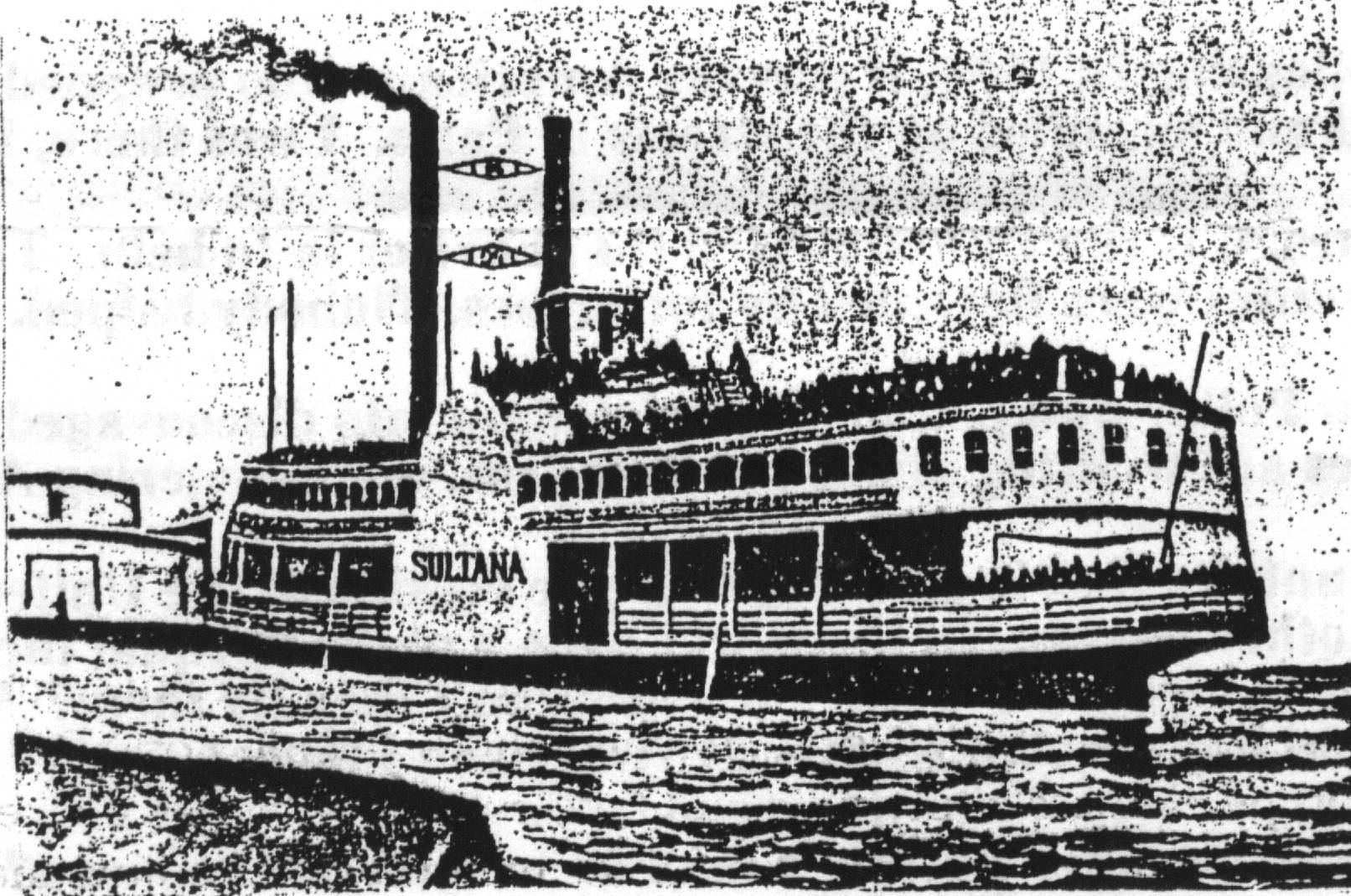
steamer "Sultana."
My company being near the rear of the column would naturally fall on
the lower deck and on the bow of the boat. We arrived at Memphis,
Tenn., on the evening of the 28th of April, and the steamer stopped and
unloaded three hundred hogsheads of sugar which detained her until
nearly eleven o'clock at night. Left there about that hour and went up
the river about four miles, where we stopped and took on a supply of
coal to last as far as Cairo, Ill., leaving the barges about two
o'clock in the morning of the 27th, when, after steaming up the river
three more miles, the explosion took place.
Taking in the whole situation at a glance I got up, put on my shoes and
waited for a favorable opportunity to leave the boat, realizing that I
was safe on the boat as long as the fire did not affect me. When the
opportunity presented itself I took off my blouse, hat and shoes,
keeping on all my underclothing, and took an ambrotype likeness of my
wife and boy, out of my blouse pocket and put it in my pants pocket so
that if I was lost and ever found it would be the means of identifying
me. I then put my left hand on the railing of the boat and jumped into
the river and commenced swimming for the shore. After being in the
water a short time a piece of board, about six inches wide and from six
to seven feet long, came floating along in front of me. Having secured
it and placed it under my breast I had no trouble in reaching an
island, but on account of high water it was overflown. After a great
amount of trouble I finally succeeded in getting out of the river into
the fork of a small tree and remained there until eight o'clock, when I
was picked up by a steamer and taken to the Soldiers Home at Memphis.
Left there the second day for Michigan. Was discharged from the service
as a veterinary surgeon, at Detroit, July 7, 1865.
Obituary of Benjamin F. Johnston
Benjamin F. Johnston... Is Mustered Out
The ever sounding taps which day by day, year by year, are reducing the
struggling ranks of the noble heroes of '61, were called for Benjamin
F. Johnston on Sunday afternoon, March 1st, 1914, when that Comrade
passed his Commander in final review and joined the host in that last
encampment on that other shore! He was born in Geneseo, Livingston Co.
New York, March 23, 1829, and at the age of 19, he came to Almont and
learned the printer's trade. He worked at his trade summers and taught
school here and in New York and Pennsylvania for eight years during the
school season.
When the war cloud hung over the country in the 60's he helped to raise
the first Michigan Calvary. Later he enlisted in the 5th Michigan
Calvary, August 26th '62 which was with the army of the Potomac during
most of the war. He served under Kilpatrick and Custer and was with
Kilpatrick in the famous raid on Richmond in March '64. Was captured,
June 11th '64 at Trevelian Sta. Va., and was a prisoner at Richmond,
Libby Prison and Andersonville for a period of nine months. Was paroled
after Lee's surrender and on his way north he boarded the ill fated
steamer Sultana
which was blown up on the Mississippi River and out of a total of 2208
passengers only between 600 and 700 were saved. Following his army
career he returned home waiting orders, and was mustered out July 5,
'65.
Mr. Johnston has always been an active member of the Congregational
Church, serving that society as Deacon and Trustee for many years. He
was prominent in the Masonic Fraternity, having been Master of the
Lodge and High Priest of the Chapter of Almont and an officer of the
Grand Lodge of Michigan. He was always deeply interested in the Masonic
work.
In village affairs he was never idle, and carried the same
characteristic interest in public matters as he did in others. He
served as village president, trustee on the school board, and Justice
of the Peace.
The funeral service was held at his old home residence on Wednesday
afternoon in charge of the Masonic order. Rev. Mr. Endy made a few
brief remarks appropriate to the Christian life the deceased had lived,
and his remains were laid in the family lot in the Almont Cemetery.
HISTORY OF A DISASTER WHERE OVER ONE THOUSAND
FIVE HUNDRED HUMAN BEINGS WERE LOST, MOST OF THEM BEING EXCHANGED
PRISONERS OF WAR ON SUFFERING FROM ONE TO TWENTY-THREE MONTHS IN CAHABA
AND ANDERSONVILLE PRISONS.
The Steamer Sultana
was built in Cincinnati, Ohio, January 1863. She was a regular St.
Louis and New Orleans packet. April 21, 1865 she arrived at Vicksburg,
Miss. & loaded on 1,965 federal solders and 35 officers just
released from Cahaba, Ala., Macon and Andersonville. The men were from,
Michigan, Ohio, Indiana, Tennessee, Kentucky and West Virginia. Besides
two companies of infantry under arms. The ship burned on April 27,
1865. On December 30, 1885 at a convention called in Fostoria, Ohio
there was a committee appointed consisting of A. C. Brown, P. L. Horn,
Wm Fies, A. W. King and G. N. Clinger to prepare a suitable memorial
and present the same to congress praying for a pension for each of the
survivors of the lost Sultana.
---this history is from the book, "Loss of the Sultana and Reminiscences of Survivors" by Rev. Chester D. Berry. Printed 1892